Bible Accurate Angels: 7 Powerfull Truths From Scripture
Most of us grew up picturing soft, glowing figures with feathered wings and a gentle smile. Then you open the Bible and meet a creature covered in eyes, spinning wheels, and four faces. That gap is startling, and it’s why so many people are searching for bible accurate angels right now.
This guide walks through what Scripture actually says about angels, from seraphim and cherubim to Michael, Gabriel, and the fallen ones. You’ll see the verses, the context, and the meaning behind each image. Stay with me, because the real picture is stranger and more awe-inspiring than any painting.
Real angels in the bible
Real angels in the Bible are not decorations. They are created spiritual beings who serve God, carry divine messages, guard holy places, and sometimes fight on behalf of His people. Scripture names them as part of the heavenly host, a vast angelic army beyond counting.
What stands out is how little they resemble modern art. They are powerful, often frightening, and consistently point attention to God rather than themselves. Anyone searching for bible accurate angels has to start here: Scripture treats them as servants, never as celebrities.
Biblical representation of angels

The biblical representation of angels varies widely. Some appear as ordinary men, like the three visitors Abraham fed in Genesis 18. Others show up in blazing visions, like Isaiah’s seraphim or Ezekiel’s living creatures.
This range matters. The Bible never gives one fixed look for angels. It gives a pattern: when the heavenly messenger needs to blend in, they look human, and when the vision is about God’s glory, they look overwhelming. Reading both sides keeps us honest about what bible accurate angels truly look like.
Biblically accurate angels scripture
When people ask for biblically accurate angels scripture, the core passages are Isaiah 6, Ezekiel 1 and 10, Genesis 3:24, Exodus 25, Daniel 8 to 12, and Revelation 4 to 20. These are the texts that describe wings, faces, wheels, and weapons.
Reading them side by side shows how consistent the angelic imagery is. Wings cover faces in reverence. Eyes signal divine knowledge. Fire points to holiness. Each detail carries meaning, which is why the original wording matters more than later art.
Biblically accurate angel scripture
If you want biblically accurate angel scripture you can read in one sitting, start with Isaiah 6:1-7, then Ezekiel 1:4-28, then Revelation 4:6-8. Together they cover seraphim, living creatures, and cherubim-like beings around the throne of God.
Add Luke 1 and 2 for the gentler side, where Gabriel and a crowd of heavenly host appear to Mary and the shepherds. Reading the intense visions next to the personal encounters gives you the full range of what Scripture says.
The Biblical Foundation of Angels
The biblical foundation of angels begins before humanity. Job 38:7 pictures the morning stars singing and the sons of God shouting at creation, which hints that angels were present early. Colossians 1:16 confirms that all heavenly beings were created by and for Christ.
This foundation shapes everything else. Angels are not eternal, not divine, and not equal to God. They are creatures with real power, real limits, and a purpose assigned by their Creator, a point every study of bible accurate angels should anchor on.
What Scripture Reveals About Angels
Scripture reveals that angels worship, serve, announce, protect, and judge. They are described as mighty, holy, and innumerable, yet always under God’s authority.
- Angels exist as created beings who worship God continually, as shown in Isaiah 6 and Revelation 4.
- They act as messengers, delivering news like the births of Isaac, Samson, John, and Jesus.
- They protect and rescue, as in Daniel 6, Acts 5, and Acts 12.
- They carry out divine judgment, from the plagues of Egypt to the bowls of Revelation.
- They never accept worship themselves, and Revelation 22:8-9 makes that unmistakable.
Put together, these roles show a heavenly order that exists to serve God’s purposes rather than human fascination.
The Etymology and Meaning of ‘Angel’
The English word angel comes from the Greek angelos, meaning messenger. It translates the Hebrew malak, which carries the same sense. Both words describe a role more than a body type.
That’s why the term can even apply to human messengers in some passages. The etymology reminds us that “angel” is a job title first. Whenever you read about bible accurate angels, think of what they do, not only what they look like.
Angels as Spiritual Beings and Ministering Spirits
Hebrews 1:14 calls angels ministering spirits sent to serve those who will inherit salvation. They are spiritual beings, not human souls, and Scripture never says people become angels after death.
This distinction clears up a lot of confusion. Humans and angels are separate orders of creation. Angels may take physical form when needed, yet their nature is spirit, which explains why they can appear suddenly, travel instantly, and vanish.
Contrasting Biblical Angels with Popular Culture
Popular culture gives us gentle, glowing figures with halos, harps, and lace gowns. Scripture gives us fiery sentinels, warriors, and beings that leave people trembling.
The halo isn’t biblical, and the chubby baby with wings comes from Renaissance art, not Scripture. Comparing the two is the fastest way to see why bible accurate angels feel so different from what most of us imagined as children.
How Modern Media Misrepresents Angels
Movies, TV, and greeting cards often present angels as departed loved ones or soft guardians who grant wishes. Scripture never teaches that, and it rarely shows angels being comforting in a cuddly sense.
Media also tends to flatten angelic hierarchy into one kind of being. The Bible names seraphim, cherubim, living creatures, archangels, and more. Recovering that variety helps correct the picture and keeps our understanding of angels tied to the text.
Why Angels Say ‘Fear Not’ in Scripture
The phrase “Fear not” appears again and again when angels show up, in Luke 1:13, Luke 1:30, Luke 2:10, and Matthew 28:5. People don’t say that to someone who looks like a harmless cherub.
It suggests that the angelic presence was genuinely overwhelming. Daniel collapses, John falls as though dead, and the shepherds are terrified. The reassurance comes first, and then the divine message follows.
Archangels: The Named Messengers of Heaven
Scripture names only two angels directly: Michael and Gabriel. Michael is called an archangel in Jude 9, and 1 Thessalonians 4:16 mentions “the voice of the archangel,” pointing to rank among the heavenly host.
Later tradition adds names like Raphael and Uriel from non-canonical books. For readers who want strictly biblically accurate angels, the safest list from canonical Scripture is short, and each name carries a clear mission.
Michael: The Warrior Prince
Michael appears in Daniel 10 and 12, Jude 9, and Revelation 12. He is described as “one of the chief princes” and as the protector of Israel, a warrior who fights spiritual opposition.
His most dramatic scene is Revelation 12, where he and his angels battle the dragon. That image of spiritual warfare is far from soft artwork, and it fits the pattern of bible accurate angels as powerful defenders.
Gabriel: God’s Chief Herald
Gabriel delivers major announcements. He explains visions to Daniel in Daniel 8 and 9, tells Zechariah about John the Baptist, and brings Mary the news of Jesus in Luke 1.
Gabriel stands in God’s presence, as Luke 1:19 says. His role is that of herald, the one who carries divine revelation at pivotal moments in salvation history, which makes him one of the most recognized named angels.
The Unique Role of Named Angels
Named angels have distinct jobs. Michael is linked with battle and protection, while Gabriel is linked with messages and revelation. Their names themselves point to God: Michael means “who is like God?” and Gabriel means “God is my strength.”
| Angel | Main Role | Key Scripture |
| Michael | Warrior, protector of Israel | Daniel 12:1, Revelation 12:7 |
| Gabriel | Herald, interpreter of visions | Daniel 9:21, Luke 1:26 |
Seraphim: The Fiery Worshipers at God’s Throne
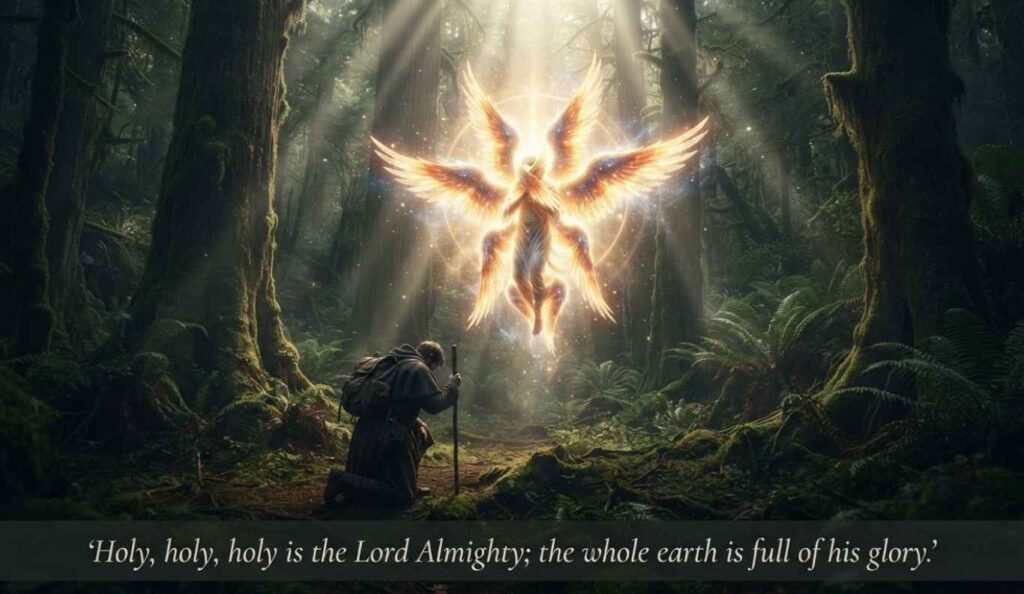
Seraphim appear only in Isaiah 6. The name comes from a Hebrew word linked to burning, which fits their fiery nature. They stand above the throne, calling out to one another in worship.
Isaiah’s vision shows how deeply holiness shakes a human being. Seraphim are not described as soft or friendly. They are burning attendants of the Lord, and they set the tone for how bible accurate angels should be understood: awe first, comfort second.
The Six Wings and Their Symbolic Meaning
Isaiah 6:2 says each seraph has six wings. Two cover the face, two cover the feet, and two are used for flying. Every pair says something.
- The covered face shows reverence, since even sinless beings cannot look at God’s full glory.
- The covered feet express humility before the Holy One.
- The two flying wings show readiness to serve instantly.
- Together they form a picture of worship and obedience, not decoration.
This detail alone shows how different biblically accurate angels are from the single pair of feathered wings seen in most art.
The Threefold Holy Proclamation
The seraphim cry, “Holy, holy, holy is the Lord of hosts” (Isaiah 6:3). Hebrew repeats a word to show the highest degree, so the triple repetition stresses God’s absolute holiness.
This is the only attribute of God repeated three times in this way in Scripture. The seraphim’s song also appears in the worship scene of Revelation 4, linking the Old and New Testaments through the same heavenly worship.
Seraphim’s Role in Purification
After Isaiah cries out that he is a man of unclean lips, one seraph flies to him with a burning coal from the altar and touches his mouth. The words are simple: your guilt is taken away and your sin is atoned for.
Here a seraph acts as God’s instrument of cleansing and commissioning. Isaiah is then ready to answer, “Here am I, send me.” It’s a powerful reminder that angels carry out God’s work, not their own.
Cherubim: The Multi-Faced Guardians of Holy Places
Cherubim are guardians of sacred space. Scripture places them at Eden, on the Ark of the Covenant, on the tabernacle curtains, and in Solomon’s temple. They are never described as babies.
The chubby “cherub” is a Renaissance invention. The Bible’s cherubim are majestic and heavily symbolic, which is one of the biggest corrections anyone makes when studying bible accurate angels.
Cherubim Guarding the Garden of Eden
Genesis 3:24 says God placed cherubim and a flaming sword at the east of the garden to guard the way to the tree of life. It’s the first appearance of cherubim in the Bible.
Their job is protective and judicial: they enforce the boundary created by sin. The detail of the whirling sword adds to the sense of danger, and it shows these beings carry real authority.
The Four Faces and Their Significance
In Ezekiel 1 and 10, the living creatures, identified as cherubim, each have four faces: a man, a lion, an ox, and an eagle. The images are rich in meaning.
- The man suggests intelligence and humanity’s place in creation.
- The lion points to strength and kingship.
- The ox points to service and sacrifice.
- The eagle points to vision and rule over the heavens.
Together they show that God’s throne is surrounded by the highest forms of every part of creation.
Cherubim on the Ark of the Covenant
Exodus 25:18-22 instructs Moses to make two golden cherubim on the mercy seat, wings spread over the ark. God says He will meet with Israel from between them.
This makes the cherubim symbols of God’s presence and throne. Psalm 80:1 even calls God the one who is “enthroned between the cherubim.” So the artwork on the ark was not decoration; it declared where heaven touched earth.
Eyes Symbolizing God’s Omniscience
Ezekiel 10:12 describes the cherubim’s bodies and wheels as full of eyes. Revelation 4:6 repeats the idea for the living creatures around the throne.
The eyes are widely read as a symbol of divine omniscience, meaning nothing is hidden from God. For anyone interested in bible accurate angels, this is one of the most striking features, and it explains why such images unsettle us at first.
Living Creatures and Ophanim: The Most Mysterious Angels
Ezekiel’s living creatures and the ophanim, or wheels, are the strangest celestial beings in the Bible. Ezekiel struggles to describe them, using words like “appearance” and “likeness.”
Many Christians treat them as one group of cherubim with attached wheel structures, while some Jewish and later traditions list ophanim as a distinct rank. Scripture itself never gives a tidy chart.
| Being | Key Feature | Main Passage |
| Living Creatures | Four faces, four wings | Ezekiel 1 |
| Cherubim | Faces, wings, eyes | Ezekiel 10 |
| Ophanim | Wheels full of eyes | Ezekiel 1:15-21 |
Ezekiel’s Vision of the Living Creatures
Ezekiel sees a storm cloud, fire, and four creatures shaped like humans, each with four faces and four wings. Their legs gleam like polished bronze, and they move like flashes of lightning.
The scene ends with a throne and a figure of glowing fire. It’s a vision about God’s glory arriving among exiles in Babylon. The creatures serve as living supports of God’s throne chariot, which is why the imagery feels so intense.
The Wheel Angels: Ophanim Explained
The word ophanim is simply the Hebrew word for wheels. In Ezekiel 1:15-21, the wheels move with the creatures because “the spirit of the living creatures was in the wheels.”
They are not described as flying bodies in the common sense, but as spirit-driven wheel structures beside the creatures. Later Jewish writings use ophanim as a rank of angels, so the word has a long reading history.
Wheels Within Wheels Covered With Eyes
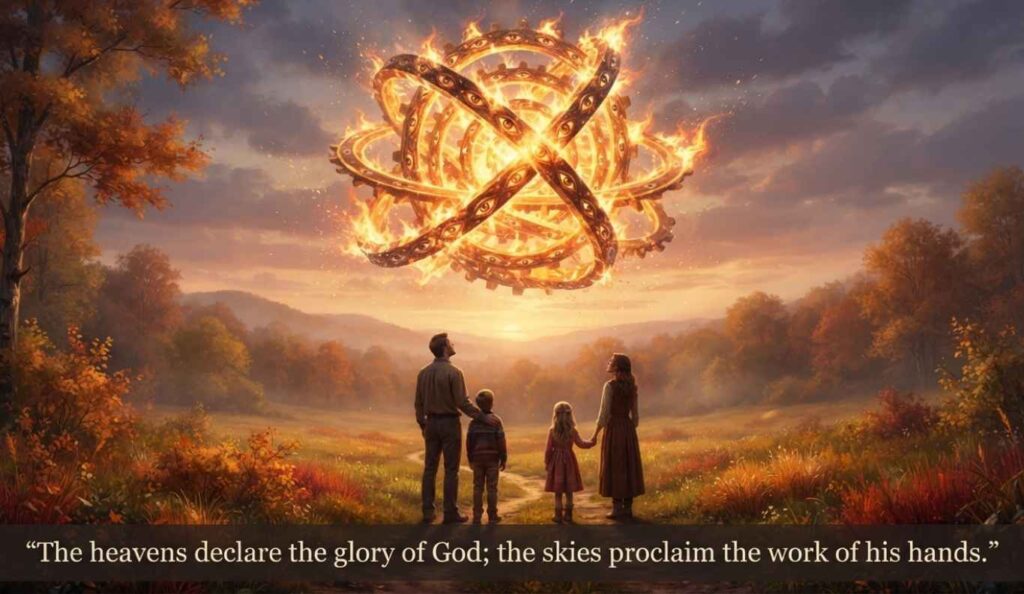
Ezekiel says the wheels looked like a wheel within a wheel, able to go in any direction without turning. Their rims were tall, awesome, and full of eyes all around.
Interpreters often see this as a picture of God’s presence moving everywhere, unrestricted and all-seeing. The design shows motion in every direction at once, which is a strong symbol of divine sovereignty.
The Relationship Between Living Creatures and Cherubim
Ezekiel 10:20 says, “These were the living creatures I had seen… and I realized they were cherubim.” That verse links the creatures of chapter 1 to the cherubim of the temple.
So the living creatures are best understood as cherubim seen in a throne vision. This helps clear up why descriptions of biblically accurate angels can overlap so much between Ezekiel, Isaiah, and Revelation.
General Angels: The Messengers Throughout Scripture
Most angels in the Bible are unnamed and unclassified. They simply appear as the angel of the Lord or “an angel” and deliver messages, rescue, or judgment.
Because they are described by function rather than rank, we see them throughout Genesis, Judges, Kings, the Gospels, and Acts. They tie the whole story of Scripture together as consistent divine messengers.
Angels Appearing in Human Form
Hebrews 13:2 says some have entertained angels without knowing it. In Genesis 18 and 19, angels look like ordinary travelers who eat and walk with Abraham and Lot.
This tells us that angels don’t always look dramatic. Sometimes the most biblically accurate angels appear so human that people can’t tell until the message or miracle comes.
The Mighty Acts Angels Perform
Angels shut lions’ mouths in Daniel 6, release prisoners in Acts 5 and 12, and strike down an army of 185,000 in 2 Kings 19:35. They also roll away a tomb stone, as in Matthew 28.
These mighty acts show angelic power under God’s direction. They remind us that angels are neither weak nor sentimental. Their strength is real, but it’s always used for God’s purposes.
Angels Holding Swords as Warriors
Several passages show angels with drawn swords. Joshua meets a commander of the Lord’s army in Joshua 5:13-15, and Balaam’s donkey sees an armed angel in Numbers 22.
- The commander of the Lord’s army tells Joshua to remove his sandals.
- The angel in Numbers 22 stands in the road with a drawn sword.
- David sees an angel with a sword stretched over Jerusalem in 1 Chronicles 21.
- Revelation 12 pictures Michael leading armies in heaven.
These images match the warrior angel idea far better than soft artwork does.
Angels in the Life and Ministry of Christ
Angels surround Jesus’ story from start to finish. They announce His birth, strengthen Him in the wilderness and Gethsemane, and appear at the resurrection and ascension.
That pattern shows angels are servants of the Son as well as of the Father. Hebrews 1 makes a point of saying Christ is greater than the angels, which keeps the focus where Scripture wants it.
Angelic Announcements of Jesus’ Birth
Gabriel tells Mary she will bear the Son of God, and an angel reassures Joseph in a dream. Then Luke 2 describes an angel and a multitude of the heavenly host praising God before the shepherds.
Notice again the “Fear not.” The shepherds were truly afraid. The announcement of Jesus’ birth is good news carried by powerful beings, and the choir is more like an army of praise than a gentle chorus.
Angels Ministering to Jesus During His Earthly Life
After the temptation in the wilderness, angels came and ministered to Him (Matthew 4:11). In Gethsemane, Luke 22:43 says an angel appeared from heaven to strengthen Him.
Jesus also said He could call more than twelve legions of angels in Matthew 26:53. That statement shows how vast the angelic host is, and how willingly the Son chose the cross instead.
Angels at the Resurrection and Ascension
At the tomb, an angel like lightning rolled the stone away, and the guards shook with fear (Matthew 28:2-4). Women then hear, “He is not here; He has risen.”
At the ascension, two men in white told the disciples Jesus would return the same way (Acts 1:10-11). Angels bookend the resurrection and ascension with clear, reassuring truth.
Jesus’ Teaching About Angels and Judgment
Jesus speaks of angels gathering the elect and separating the wicked at the end of the age (Matthew 13:41-49; 24:31). He also says angels in heaven rejoice over one sinner who repents (Luke 15:10).
He taught that angels neither marry nor die (Luke 20:36). These statements give us reliable teaching about angelic nature and role, straight from Christ rather than from tradition.
Angelic Activity in Acts and the Early Church
Acts is full of angels. One frees the apostles from jail (5:19), another directs Philip to the Ethiopian (8:26), and one visits Cornelius (10:3).
These stories show angels advancing the gospel, usually through quiet, practical help. They open doors, give directions, and prepare hearts, but the apostles still do the preaching.
Angels Guiding the Spread of the Gospel
In Acts 8, an angel sends Philip south, and the Spirit then moves him on. In Acts 10, an angel tells Cornelius to send for Peter, which leads to the gospel reaching the Gentiles.
In Acts 12, an angel breaks Peter’s chains, and the church is stunned. These scenes show angelic guidance working alongside prayer and human obedience, never replacing them.
Angels Executing Divine Judgment
Acts 12:23 says an angel struck down Herod because he accepted worship and did not give glory to God. Earlier, an angel carried out judgment on Egypt’s firstborn and on Sennacherib’s army.
These accounts remind us that angels also serve as agents of divine justice. It’s a sobering side of biblical angels that popular culture usually ignores.
Paul’s Theological Insights About Angels
Paul writes that angels will be judged by believers (1 Corinthians 6:3), warns against worshiping angels (Colossians 2:18), and says even an angel who preaches another gospel should be rejected (Galatians 1:8).
He also lists principalities and powers in the heavenly realm. His view is balanced: angels are real and significant, but Christ is supreme over them all.
Angels in the Book of Revelation
Revelation has more angelic action than any other book. Angels announce judgments, carry scrolls, hold back winds, and guide John through his visions. This is where bible accurate angels appear at their most intense.
| Scene | Angelic Role | Reference |
| Seven trumpets | Announce judgments | Revelation 8-11 |
| Seven bowls | Pour out God’s wrath | Revelation 16 |
| War in heaven | Michael fights the dragon | Revelation 12 |
| Binding of Satan | Angel with chain and key | Revelation 20 |
Seven Angels With Seven Trumpets
In Revelation 8, seven angels stand before God and receive seven trumpets. Each blast brings a new wave of judgment on the earth, sea, rivers, and sky.
The trumpets echo ancient warnings such as Jericho’s walls and the Exodus plagues. They show angels as heralds of divine judgment, and they build toward the final victory of God’s kingdom.
Angels Pouring Out God’s Wrath
In Revelation 16, seven angels pour out seven bowls of wrath on a rebellious world. Each bowl brings a specific disaster, ending with a global earthquake and hail.
The scene ties justice and mercy together, because God warns, delays, and then acts. Angels carry out the sentence but don’t decide it, which keeps them in their proper role as servants.
Michael’s War Against the Dragon
Revelation 12:7-9 describes a war in heaven where Michael and his angels fight the dragon, “that ancient serpent called the devil or Satan.” The dragon loses and is hurled to the earth.
This passage links Michael to the final defeat of evil. It also shows that spiritual conflict has real stakes, and that God’s forces triumph through the blood of the Lamb.
The Angel Binding Satan
In Revelation 20:1-3, an angel descends with a key and a great chain, seizes the dragon, and binds him for a thousand years. He’s thrown into the abyss, which is sealed.
The point is not the angel’s identity but the total authority angels have under God’s command. Satan, once powerful, is controlled by a single obedient angel.
The Biblical Truth About Guardian Angels
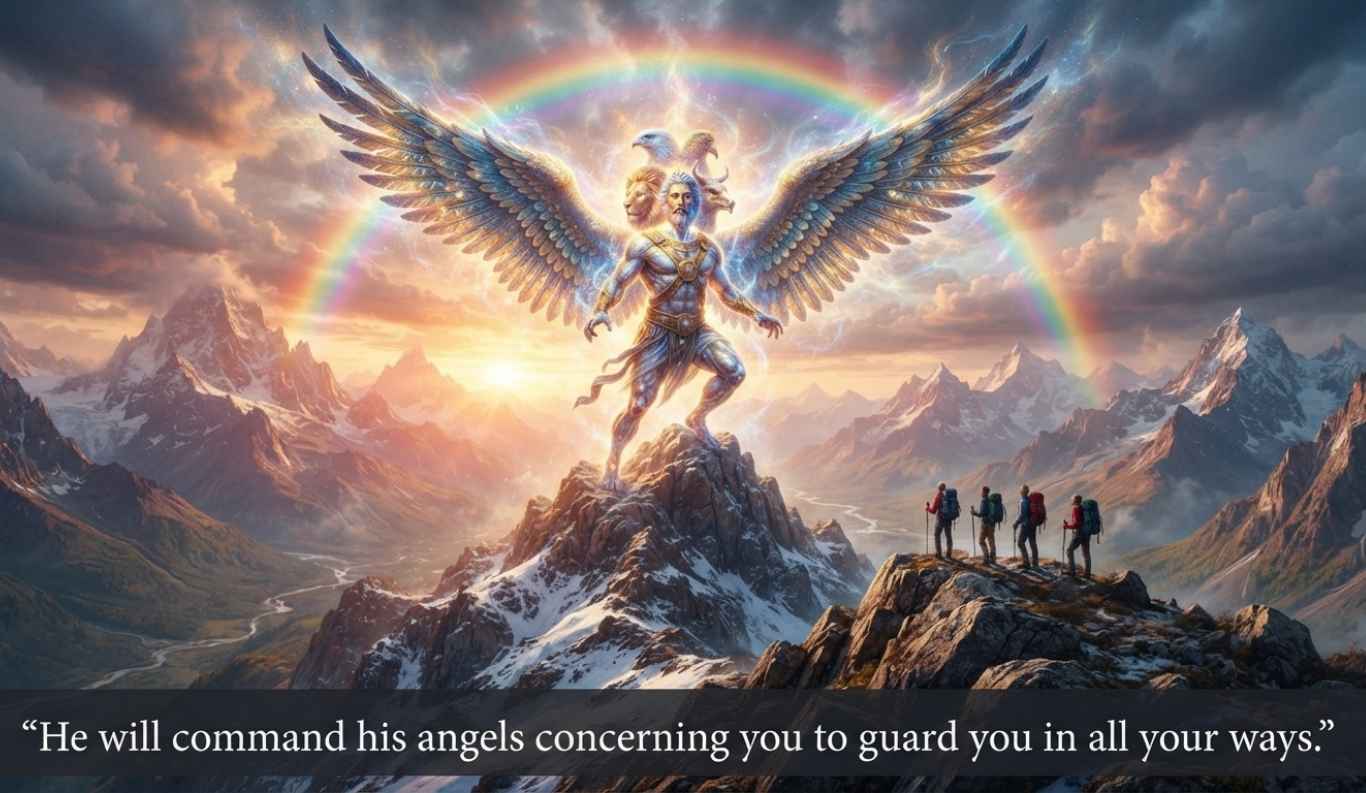
Scripture does support angelic protection, though not in the exact way many people picture. Psalm 91:11 says God commands His angels to guard you, and Hebrews 1:14 calls angels servants sent for believers.
What the Bible doesn’t do is give a detailed doctrine of a personal guardian angel assigned at birth. The truth sits between two extremes: angels do protect, but God remains the source.
What Scripture Actually Teaches About Personal Protection
Matthew 18:10 says children have angels who always see the Father’s face, and Acts 12:15 records believers saying “It must be his angel” about Peter. These verses suggest some personal angelic care.
Still, Scripture never tells us to pray to angels or rely on them. It points us to God’s care first. Seeing guardian angels through that lens keeps the doctrine healthy and biblical.
Communal Versus Individual Angelic Ministry
Many angelic passages describe groups and communities rather than individuals. Angels guard Israel, protect Jerusalem, and surround the faithful together, as in Psalm 34:7.
So the Bible leans toward communal angelic ministry while leaving room for individual care. That balance explains why some verses speak of “the angel of the Lord” encamping around those who fear Him.
Angels Assigned to Nations and Groups
Daniel 10 mentions the prince of Persia and the prince of Greece, spiritual powers tied to nations, while Michael is called Israel’s prince. Deuteronomy 32:8 in some manuscripts also links nations to the sons of God.
Interpreters debate how to read these passages, but they suggest angelic oversight of nations and a real unseen conflict behind world events. It’s a mysterious, heavy topic that Scripture only partly unveils.
Satan’s Fall and the Origin of Fallen Angels
Fallen angels are angels who rebelled against God. Scripture never gives a single full account of the fall, but several passages are linked with it, including Isaiah 14, Ezekiel 28, Luke 10:18, and Revelation 12.
Christian tradition holds that Satan led a rebellion in which a portion of angels followed him. That origin story explains the spiritual warfare referred to throughout the New Testament.
Satan as a Fallen Cherub
Ezekiel 28:14 describes the king of Tyre as an “anointed guardian cherub” in Eden, cast down because of pride. Many readers see language that goes beyond a mere human king and hear echoes of Satan’s fall.
Interpretations differ, and some scholars read it strictly as a taunt against Tyre’s ruler. Even so, the idea of a fallen cherub has been central to how many Christians understand the origin of the devil.
The Meaning of ‘Satan’ and ‘Lucifer’
Satan is a Hebrew word meaning adversary or accuser. Lucifer comes from the Latin Vulgate’s rendering of Isaiah 14:12, “morning star” or “light-bringer,” from the Hebrew helel.
The name Lucifer became a popular name for the devil over time. Reading the passage in context shows it targets the king of Babylon, even though many believers see a deeper spiritual background behind the words.
Pride as the Root of Angelic Rebellion
Isaiah 14 and Ezekiel 28 both highlight pride as the cause of ruin. The king in Isaiah says, “I will ascend to the heavens… I will make myself like the Most High.”
1 Timothy 3:6 also warns that a new believer might fall into the same condemnation as the devil through conceit. So pride is portrayed as the seed of angelic rebellion, a warning that holds for humans as well.
Other Fallen Angels: Demons and Spiritual Rebellion
Beyond Satan, Scripture refers to demons, evil spirits, and unclean spirits who oppose God. They are not equal rivals to God, but they do real harm until they are bound or cast out.
| Group | Description | Reference |
| Demons | Spirits that afflict and deceive | Mark 5, Luke 8 |
| Angels who sinned | Held for judgment | 2 Peter 2:4 |
| Angels who left their domain | Kept in chains | Jude 6 |
The Sons of God in Genesis Six
Genesis 6:1-4 describes the sons of God taking wives from the daughters of men. Some read this as fallen angels, while others read it as the line of Seth or powerful rulers.
The debate has existed for centuries. It matters here because 2 Peter 2:4 and Jude 6 are often connected with it, though the text does not spell out the link. A careful reader should hold the view with humility.
Angels Bound in Chains of Darkness
2 Peter 2:4 says God did not spare angels who sinned but cast them into hell and committed them to chains of darkness, to be held for judgment. Jude 6 says similar things about angels who left their proper place.
The language is symbolic and sobering. It affirms that rebellion has consequences, even for powerful spirits, and that God’s judgment is certain and orderly.
Demons and Unclean Spirits in the New Testament
The Gospels show Jesus casting out demons and unclean spirits with a word. They recognize Him instantly, calling Him the Holy One of God, and they tremble (James 2:19).
These accounts are about Christ’s authority more than the demons themselves. They show that the powers of darkness are real, but they are not equal to the power of Jesus.
Thrones: Angels Biblically Accurate
Colossians 1:16 lists thrones, dominions, rulers, and authorities as things created by Christ. Many Christians treat these as ranks of angelic hierarchy, though Scripture gives no description of what they look like.
Popular lists of thrones as wheels or fiery wheels come from later tradition. For bible accurate angels, the careful statement is that thrones are named, yet their appearance is not described.
Description of Angels in the Bible: Revelation
Revelation gives the richest descriptions. One angel is clothed in a cloud with a rainbow over his head and legs like pillars of fire (Rev 10:1). Others fly in midheaven, hold censers, or wear golden sashes.
The living creatures around the throne have six wings and eyes all around (Rev 4:8). These visuals are strongly symbolic, which means they carry meaning beyond a plain physical picture.
Verses About Angels: Appearance
Not every verse describes looks, but several give clues. Together they show variety rather than a single standard look.
| Verse | Appearance |
| Isaiah 6:2 | Six wings, fiery seraphim |
| Ezekiel 1:5-10 | Four faces, four wings |
| Daniel 10:6 | Body like beryl, face like lightning |
| Matthew 28:3 | Appearance like lightning, clothing white as snow |
| Hebrews 13:2 | Human-looking visitors |
Do Angels Have Wings?
Some do. Seraphim and cherubim have wings, and Revelation shows angels flying in midheaven. Daniel 9:21 says Gabriel came “in swift flight.”
- Seraphim have six wings, as in Isaiah 6.
- Cherubim and living creatures have wings in Ezekiel and Exodus.
- Many angels appear as ordinary men with no mention of wings.
- Wings often signal speed, covering, and reverence.
So the answer is: sometimes, depending on the type of angel and the vision.
What Do Bible Accurate Angels Really Look Like?
Bible accurate angels can look like glowing men, flaming seraphim, four-faced cherubim, or wheels full of eyes. Scripture offers multiple appearances, not one image.
The shared theme is awe and holiness. Whatever the form, people respond with fear and worship, which tells us the real angelic presence is far from a gentle portrait on a greeting card.
How Many Types of Angels Are in the Bible?
The Bible names several kinds: archangels, seraphim, cherubim, living creatures, and general angels, along with thrones, dominions, rulers, and authorities in Paul’s letters.
It never gives a complete numbered chart. The famous nine-choir hierarchy comes from later writers like Pseudo-Dionysius. For bible accurate angels, the safest answer is that Scripture names several types without ranking them all.
Are Angels Mentioned in the Old Testament and New Testament?
Yes. Angels appear from Genesis to Revelation, with roughly 270 mentions across the Bible depending on the translation. The Old Testament includes cherubim, seraphim, and the angel of the Lord.
The New Testament adds Gabriel’s announcements, Christ’s ministry, Acts, and Revelation. The consistent message across both testaments is that angels serve and glorify God.
Can Angels Be Seen by Humans Today?
The Bible says people have met angels, sometimes without realizing it (Hebrews 13:2). It doesn’t promise that every believer will see one, and it warns against chasing visions.
Paul also cautions that Satan can disguise himself as an angel of light (2 Corinthians 11:14). So any claim about an angelic encounter should be tested against Scripture.
Are Cherubs the Same as Biblically Accurate Angels?
No. The little winged babies called cherubs come from Renaissance art and Greek putti, while the Bible’s cherubim are guardian beings with multiple faces and wings.
That distinction is one of the easiest ways to separate pop imagery from biblically accurate angels. Cherubim are powerful, holy, and often terrifying, not cute.
Frequently Asked Questions
What are bible accurate angels?
Bible accurate angels are heavenly beings described as they appear in Scripture, such as seraphim, cherubim, and messengers, often with wings, eyes, fire, or human form.
Do bible accurate angels have six wings?
Only the seraphim in Isaiah 6 are given six wings. Many bible accurate angels have two or four wings, and some appear without wings at all.
Are bible accurate angels scary?
Often yes. Bible accurate angels regularly cause fear, and that’s why “Fear not” is such a common opening line when they deliver messages.
Are there only two named angels in the Bible?
Scripture names only Michael and Gabriel. When people list bible accurate angels by name beyond these two, they usually rely on non-canonical or later traditions.
Are cherubim and seraphim the same?
They are different. Seraphim are fiery worshipers in Isaiah 6, while cherubim guard holy places. Both belong among bible accurate angels, but with distinct roles.
Does the Bible teach guardian angels?
It teaches angelic protection in places like Psalm 91 and Matthew 18:10, though it doesn’t give a full doctrine. Bible accurate angels serve God’s people, not the other way around.
Should we pray to angels?
No. The Bible directs prayer and worship to God alone, and Revelation 22:9 shows an angel refusing worship. Bible accurate angels always point to God.
Conclusions
Studying bible accurate angels changes the picture. Instead of soft figures with halos, Scripture gives us fiery seraphim, multi-faced cherubim, mighty warriors like Michael, and humble messengers who deliver news and then step back. Every description points to God’s holiness.
The details can feel strange at first, but they have meaning. Eyes, wings, faces, and wheels all say something about worship, knowledge, and power. Reading them carefully gives us a healthier view of angels as servants and not objects of devotion.
So the next time you see a cartoon cherub, remember what the text says. Open Isaiah 6 or Ezekiel 1 and read the real bible accurate angels for yourself, and let their awe lead you back to the One they serve.

Emma Collins is an SEO expert in Blessings niche, creating optimized content for celebration, greetings, and ranking websites. EEAT expert.