
Biblically Accurate Lucifer:20+ The Shocking Truth
Picture the devil and you probably see red skin, horns, and a pitchfork. Then someone opens a Bible and asks where that picture comes from, and the room goes quiet. That gap between culture and Scripture is why people search for biblically accurate Lucifer in the first place.
This guide shows what Scripture teaches about the biblically accurate Lucifer, Satan, fallen angels, and the angel who binds him. You’ll get clear verses, simple tables, and honest notes where scholars disagree. If you want the real picture instead of the Halloween one, keep reading, because Lucifer may not be who you were taught.
What Is the Biblically Accurate Satan?
Start with the word itself. Satan comes from the Hebrew ha-satan, meaning “the adversary” or “the accuser.” In the divine council scene of Job 1:6, he walks in among the “sons of God” and speaks to God directly. He acts like a prosecutor, not a king of fire.
The Bible gives no physical portrait of him. What it gives are images: the serpent of Genesis 3, a roaring lion in 1 Peter 5:8, a great dragon in Revelation 12, and an angel of light in 2 Corinthians 11:14. Jesus called him the father of lies in John 8:44, which tells you his main weapon is deception, not brute force.
Most importantly, he is a created being. In Job, he needs permission before touching Job’s family or health. That is the foundation for any biblically accurate Lucifer study: real power, firm limits.
| Popular image | What Scripture says |
| Red skin, horns, tail | No physical description; serpent, lion, dragon are symbols |
| Ruler of hell | Hell is his place of judgment (Revelation 20:10) |
| Equal rival to God | Created and limited by God |
| Loud and obvious | Disguised as an angel of light |
Satan’s Fall and the Origin of Fallen Angels

Jesus said in Luke 10:18, “I saw Satan fall like lightning from heaven.” The statement is short, but it describes a sudden, complete removal from a place of heavenly standing. Revelation 12:7–9 adds a war in heaven, where Michael and his angels fight the dragon and his angels, and the dragon is thrown down to earth.
That is where the idea of the fallen angel host comes from. Revelation 12:4 mentions the dragon sweeping a third of the stars, which many readers take as a symbol for angels who followed him. Jude 6 and 2 Peter 2:4 speak of angels who sinned and were held for judgment.
Scripture never gives one tidy origin story. Instead, it gives pieces that Christian tradition has joined together over centuries.
- Luke 10:18 describes Satan’s fall as swift and decisive, like a flash of lightning.
- Revelation 12 pictures a heavenly war ending with the dragon and his angels cast out.
- Jude 6 says some angels abandoned their proper place and now await judgment.
- Matthew 25:41 speaks of eternal fire prepared for the devil and his angels.
- The Bible gives no exact date, which is why scholars debate when the fall happened.
Satan as a Fallen Cherub
Ezekiel 28 is the main passage behind this idea. After condemning the human king of Tyre, the prophet’s language shifts. He speaks of one “in Eden, the garden of God,” adorned with jewels, and calls him an anointed cherub placed on God’s holy mountain. He was blameless “from the day you were created,” until wickedness was found in him.
Many theologians read this as reaching beyond the human ruler to the spiritual power behind him. Others hold that it is poetic hyperbole about a proud king. Both views take the text seriously, so hold your conclusion with some humility.
Notice the rank. Cherubim guard sacred space: they stand at Eden’s entrance in Genesis 3:24 and cover the mercy seat in Exodus 25. Seraphim, by contrast, appear only in Isaiah 6 and are worshippers.
| Cherubim | Seraphim | |
| Key passage | Ezekiel 28; Genesis 3:24 | Isaiah 6:1–7 |
| Main role | Guarding God’s holiness | Worship and purification |
| Link to Satan | Ezekiel 28:14 (debated) | None in Scripture |
So when people ask which angel the biblically accurate Lucifer was, the traditional answer is a cherub, not a seraph.
The Meaning of “Satan” and “Lucifer”
These two names are not the same kind of word. “Satan” is a Hebrew title describing a role. “Devil” comes from the Greek diabolos, meaning “slanderer.” “Lucifer” is different again. It is Latin.
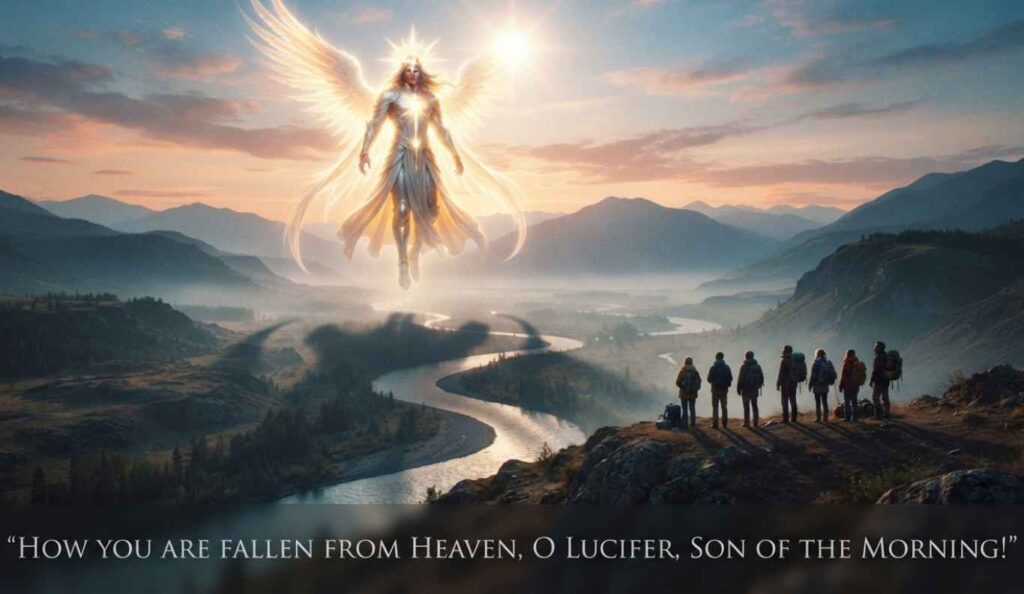
The Hebrew behind it is helel ben shachar, found once in Isaiah 14:12, often rendered “shining one, son of the dawn,” or morning star. Jerome translated it as lucifer, a common Latin word meaning light-bearer, in the Latin Vulgate. The King James Version kept that Latin word, and from there English readers took it as a personal name.
Modern translations such as the NIV and ESV avoid the name and say “morning star” or “day star.” That single translation choice explains much of the confusion about Lucifer.
| Term | Language | Meaning |
| Satan | Hebrew | Adversary, accuser |
| Devil (diabolos) | Greek | Slanderer |
| Helel | Hebrew | Shining one |
| Lucifer | Latin | Light-bearer |
Pride as the Root of Angelic Rebellion
Every major passage on his fall points to the same cause: pride. Ezekiel 28:17 says his heart was lifted up because of his beauty and that he corrupted his wisdom for the sake of his splendor. He was not tempted by weakness. He was undone by his own greatness.
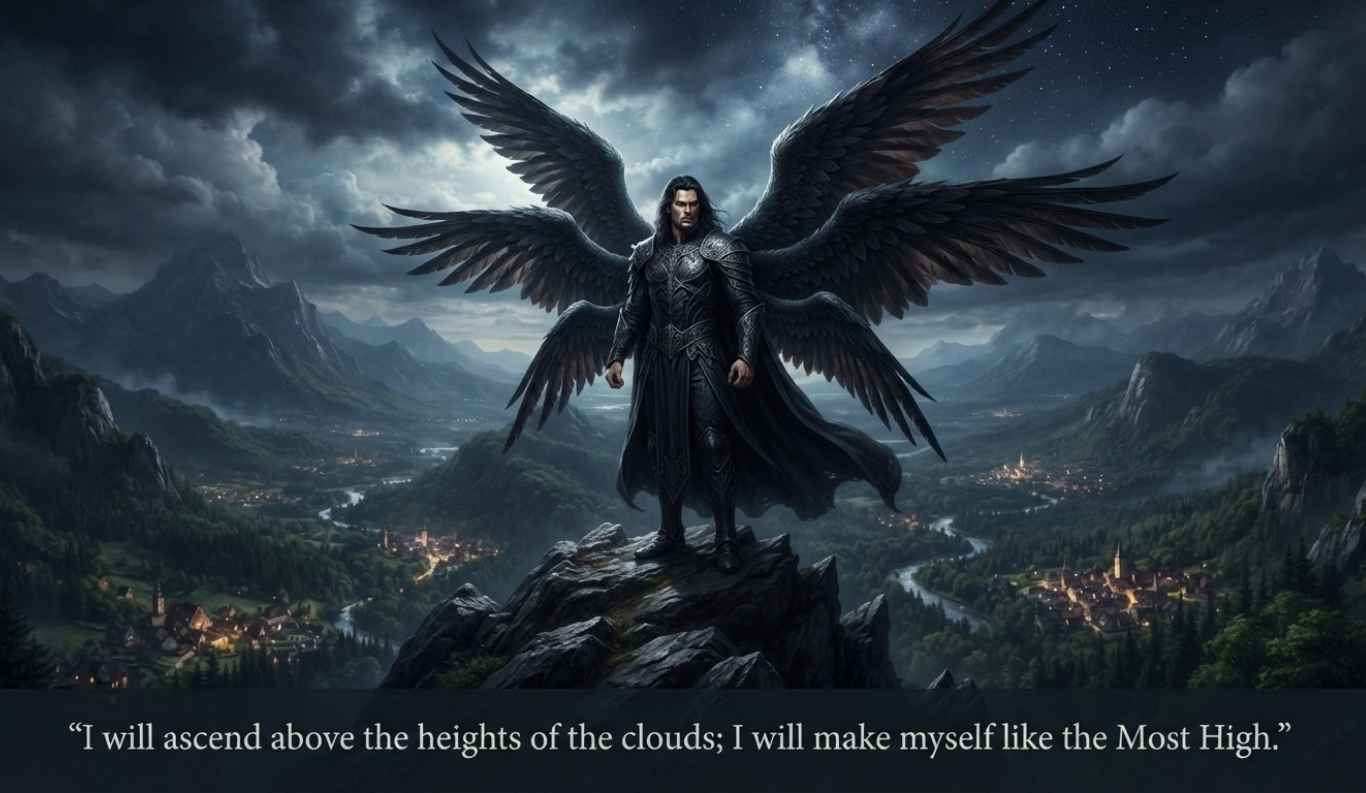
Isaiah 14:13–14 sounds the same note in a taunt against Babylon’s king, with five boasts that begin “I will,” climaxing in “I will make myself like the Most High.” Whether you read it as about a human ruler, Satan, or both, the pattern is plain. 1 Timothy 3:6 even warns that a new believer made a leader too early may fall into the same condemnation as the devil through conceit.
The pattern is easy to recognize in ordinary life:
- Pride begins by admiring a gift and ends by demanding the glory that belongs to the Giver.
- Proverbs 16:18 says pride goes before destruction, and Satan’s story is the oldest example.
- Rebellion in Scripture is rarely loud at first; it starts as a quiet “I deserve more.”
- Humility is the opposite posture, which is why James 4:7 pairs submission with resistance.
- Pride makes deception work, because a proud heart wants to believe flattering lies.
The Angel Binding Satan
Revelation 20:1–3 shows an angel coming down from heaven holding the key to the bottomless pit and a great chain. He seizes the dragon, “that ancient serpent, who is the devil and Satan,” binds him for a thousand years, and seals him in so he cannot deceive the nations.
Scripture does not name this angel. Jude 9 shows Michael the archangel declining to rebuke the devil on his own authority, which reminds us even high angels act under God’s command. The binding itself shows who holds the keys: God does.
Christians read the thousand years in different ways, and the lake of fire in Revelation 20:10 remains the final fate in each view.
| View | How it reads the binding |
| Premillennial | A future, literal reign of Christ with Satan bound |
| Amillennial | Satan is bound now, so the gospel reaches the nations |
| Postmillennial | The gospel advances; Satan’s influence steadily weakens |
Biblically Accurate Lucifer Appearance: What Did He Look Like?
Here is the honest answer: Scripture never gives one fixed face. The closest portrait is Ezekiel 28, which describes a being “full of wisdom and perfect in beauty,” covered in precious stones like carnelian, topaz, and emerald. That is a picture of splendor, not horror.
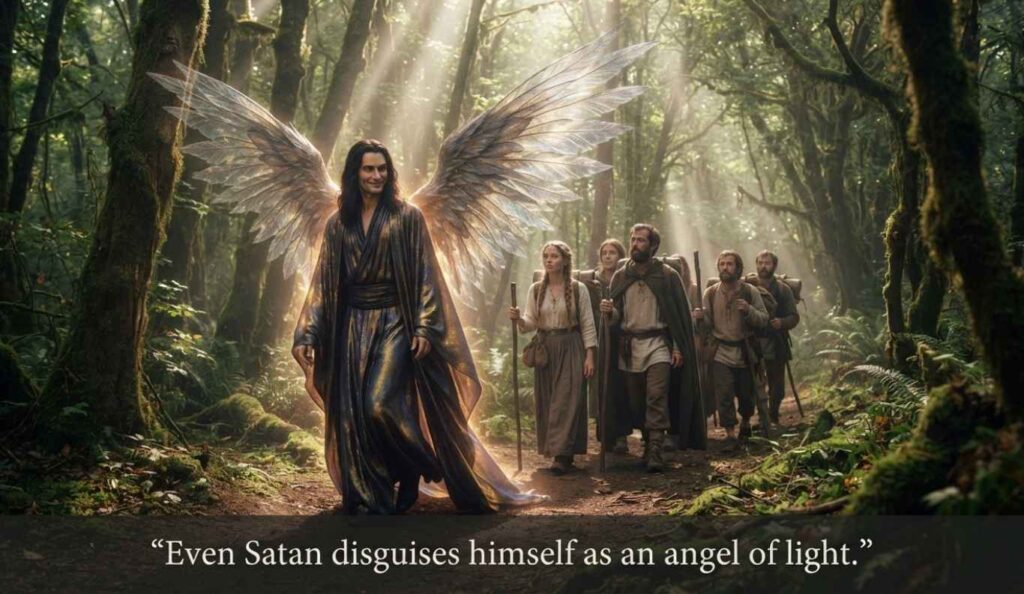
Later, the New Testament warns that Satan “disguises himself as an angel of light.” The danger is attractiveness, not ugliness. The biblically accurate Lucifer would look appealing, wise, and reasonable.
The horns and hooves came from elsewhere. Leviticus 17:7 mentions se’irim, “goat demons,” and medieval artists borrowed the imagery of the Greek god Pan, which blended into the devil of the Middle Ages. Red came from fire and the red dragon of Revelation.
That matters for you. If you expect evil to look obvious, you will miss it when it arrives polite and persuasive.
Isaiah 14 and Ezekiel 28: Is Lucifer Really Satan?
Context is everything. Isaiah 14:4 introduces the chapter as a taunt “against the king of Babylon.” In ancient Near Eastern poetry, kings were praised in cosmic language, so falling from heaven could describe a ruler’s collapse. Ezekiel 28 is likewise addressed to the king of Tyre.
Still, many readers feel the language outruns any human king: being in Eden, being a cherub, being blameless from creation. Early church fathers like Origen and Tertullian applied these passages to Satan, and that reading became the dominant tradition.
The most careful approach holds both threads: the primary target is a human ruler, and the imagery may also echo the spiritual power behind that pride. Luke 10:18 and Revelation 12 independently support a fall, so the doctrine does not rest on these two chapters alone.
| Passage | Stated target | Common traditional reading |
| Isaiah 14:12–15 | King of Babylon | Satan’s pride and fall |
| Ezekiel 28:12–17 | King of Tyre | Satan as a guardian cherub |
Is Lucifer Mentioned in the Bible as Satan’s Name?
Not directly. The English word “Lucifer” appears in the KJV only once, in Isaiah 14:12, and the verse never says “Satan.” The identification came through later interpretation, not a plain statement in the text.
Even the word itself is not exclusive. The same idea of a bright morning star is applied to Jesus in Revelation 22:16, where he calls himself the “bright morning star.” A name that can describe Christ is clearly not a secret label for the devil.
None of this means Satan is a fiction. The New Testament names him as Satan, the devil, the serpent, the tempter, and the accuser. It simply means that when you ask what the biblically accurate Lucifer is called, the careful answer is: Scripture’s own names for him are Satan and the devil, and “Lucifer” is a tradition layered on Isaiah 14.
Biblically Accurate Demons and Fallen Angels
If Satan fell, who fell with him? Scripture speaks of the “devil and his angels” (Matthew 25:41) and describes demons as unclean spirits, lying spirits, and the dragon’s angels. Most Christians understand these as the same fallen host. Some ancient Jewish texts, such as 1 Enoch, give a different origin, but those writings are not canonical for most traditions.
Demons are not given bodies in general. Even in Mark 5, the man possessed by “Legion” meets spirits, not creatures with horns, and Jesus commands them with a word. Revelation 9’s locust-like beings are apocalyptic symbols, not field guides.
What Scripture stresses is their limits:
- They obey Jesus’ authority when he commands them, as in Mark 5:1–20.
- Colossians 2:15 says Christ disarmed the powers and made a public spectacle of them.
- Ephesians 6:12 locates the struggle in spiritual forces, not physical monsters.
- Their influence is real, but always within what God allows.
Lucifer in Popular Culture vs Scripture
Much of what people call “biblical” about Lucifer comes from literature. Dante pictured Satan frozen at the center of hell, chewing traitors. Milton’s Paradise Lost (1667) gave him a charismatic voice and the famous idea that it is better to rule in hell than serve in heaven. Neither is Scripture.
Modern media adds more layers: horror films about possession, a charming nightclub-owner devil on television, and symbolic Satanism used for political protest. Each says something about culture, not about the text.
| Source | Image it gave | Biblical basis |
| Dante | Ruler of a frozen hell | Very little |
| Milton | Heroic rebel king | Mostly literary |
| Medieval art | Horned, red devil | Borrowed pagan imagery |
| Revelation | Dragon, serpent | Symbolic apocalyptic language |
Reading the biblically accurate Lucifer means setting those sources down for a while and letting the verses speak first.
Does Satan Rule Hell According to the Bible?
No. This is one of the most common misunderstandings. In Revelation 20:10, the devil is thrown into the lake of fire, which makes it his place of judgment, not his throne room. Matthew 25:41 says the eternal fire was prepared for the devil and his angels, not given to him as a kingdom.
Where does Scripture place his current activity? Paul calls him the “ruler of the kingdom of the air” in Ephesians 2:2, and Jesus calls him the ruler of this world in John 12:31, then says he will be driven out. The picture is a defeated usurper operating on borrowed time, not a king in command of a lower realm.
That matters because the myth quietly turns Satan into God’s equal opposite. Scripture refuses that. Even in the book of Job, he cannot act without permission, and in Revelation, one angel with a chain is enough to bind him.
How Can Believers Resist Lucifer and Satan Today?
The Bible’s instructions are surprisingly simple. James 4:7 says to submit to God, resist the devil, and he will flee. Peter adds that believers should stay alert and sober-minded, since the adversary prowls like a lion (1 Peter 5:8).
Because his main tactic is deception, the main defense is truth. Ephesians 6 describes the belt of truth, the shield of faith, and the sword of the Spirit, which is God’s word. Jesus himself answered every temptation in Matthew 4 with Scripture.
Practical steps that fit the text:
- Test every thought against what Scripture actually says, not what culture assumes.
- Pray with confidence, remembering Jesus prayed for Peter in Luke 22:31–32.
- Stay in community, since isolation makes spiritual warfare harder.
- Confess pride early, because that is where this story began.
- Avoid both obsession and denial: be aware of him without being dominated by fear.
Frequently Asked Questions
What Does the Bible Actually Say the Biblically Accurate Lucifer Looks Like?
The biblically accurate Lucifer has no horns or pitchfork in Scripture. Ezekiel 28 describes radiant beauty and jewels, and 2 Corinthians 11:14 says he disguises himself as an angel of light.
Was the Biblically Accurate Lucifer Originally a Good Angel?
Yes, in the traditional reading. The biblically accurate Lucifer was created blameless and glorious, then fell through pride, as Ezekiel 28 and Isaiah 14 are commonly understood.
Is Lucifer Another Name for Satan in the Bible?
The name appears once in Isaiah 14:12 in the KJV. The biblically accurate Lucifer idea comes from tradition linking that verse to Satan, not from a direct statement.
Is Satan Equal to God in Power?
No. The biblically accurate Lucifer and Satan are one created being under God’s authority. In Job, Satan must ask permission before he can touch Job.
Does Satan Rule Hell in the Bible?
No. The biblically accurate Lucifer is never shown ruling hell. Revelation 20:10 describes the lake of fire as his punishment, not his kingdom.
What Type of Angel Was Satan Before He Fell?
Ezekiel 28:14 calls the figure an anointed guardian cherub. In that view, the biblically accurate Lucifer was a cherub, not a seraph.
How Does Satan Attack People Today According to Scripture?
Scripture says the biblically accurate Lucifer works mostly through deception, accusation, and temptation. First Peter 5:8 compares him to a lion, and John 8:44 calls him a liar.
Conclusion
The biblically accurate Lucifer looks nothing like the costume version. Scripture shows a created, once-glorious being who fell through pride, who deceives more than he dominates, and who answers to God at every step. The name “Lucifer” itself comes from a Latin translation of Isaiah 14:12, so it is worth reading the text carefully before leaning on tradition or pop culture.
Satan is real in the Bible, but he is limited, and his end is settled. If you take one thing from the biblically accurate Lucifer story, let it be this: read the verses yourself, test what you hear against them, and let truth be your first defense.

Emma Collins is an SEO expert in Blessings niche, creating optimized content for celebration, greetings, and ranking websites. EEAT expert.