
200+ Biblically Accurate Satan: The Shocking Truth Revealed

Most of us grew up picturing a red devil with horns and a pitchfork. Then someone opens a Bible and asks, “Where does it say that?” The silence is awkward, and the real answer is surprising.
This guide lays out the biblically accurate Satan using Scripture, history, and scholarship. You’ll see what the Hebrew word means, what the Bible says about his looks, role, limits, and fate, and how Satan became the cartoon villain of pop culture. Knowing this changes how you read the Bible. Keep reading.
Biblically accurate satin
People often type “satin” when they mean the biblically accurate Satan, and the confusion is understandable. Search engines treat the two as close variants. The correct word is Satan, from the Hebrew satan, meaning adversary.
Whichever spelling brought you here, the answer is the same. The Bible’s adversary is far more subtle than the horned costume. Scripture presents a created spiritual being whose real weapons are lies and accusations, not fire and pitchforks.
Understanding the Biblically Accurate Satan in Scripture
To understand the biblically accurate Satan, you have to read the text before the folklore. Scripture never gives one tidy biography of Satan. It reveals him in pieces across the Old Testament and New Testament, each piece adding a new layer.
Put those layers together and a consistent figure appears: a powerful but limited spiritual adversary who tests, accuses, and deceives. He is never God’s equal. He always operates under divine sovereignty, which is the single most important point to hold onto.
The Hebrew Concept of Ha-Satan
In Hebrew, ha-satan means “the adversary” or “the accuser.” The definite article matters. In the earliest texts it is a title or job description, not a personal name, much like “the prosecutor” in a courtroom.
In the Book of Job, ha-satan appears among the sons of God in the divine council. He isn’t banished. He debates God like a prosecuting attorney. Even Numbers 22:22 calls the angel of the Lord a “satan” against Balaam, showing the word described a function before it described a being.
Satan’s Transformation Across Biblical Texts
The portrait of Satan grows over time. In Job he is a court official. In 1 Chronicles 21:1 he incites David to take a census, an event 2 Samuel 24:1 credits to God’s anger. That shift shows theology developing after the exile.
By the New Testament, he is a full spiritual enemy. Jesus tells His disciples in Luke 10:18 that He saw Satan fall like lightning. Revelation names him the ancient serpent and dragon. Scholars call this progressive revelation, not contradiction.
Distinct Roles Across Old and New Testaments
The two testaments emphasize different jobs. The table makes the contrast easy to see.
| Aspect | Old Testament | New Testament |
| Main role | Tester and accuser | Tempter, deceiver, enemy |
| Setting | Heavenly court | Earth and the spiritual realm |
| Key texts | Job 1–2, Zechariah 3 | Matthew 4, 1 Peter 5:8 |
| His fate | Rarely mentioned | Defeated, judged (Rev. 20) |
The Old Testament Satan works inside God’s permission. The New Testament adds the theme of defeat and final judgment. Together they give the complete picture.
Characteristics of the Biblically Accurate Satan
The defining traits of the biblically accurate Satan are not brute strength. They are cunning, patience, and persuasion. Scripture rarely shows him forcing anyone. It shows him asking questions, planting doubt, and exploiting what people already want.
Four traits show up again and again: he accuses, he tempts, he deceives, and he stays inside limits God sets. The next four sections take each one in turn.
Satan’s Functions and Symbolic Significance
Scripture gives Satan three core functions. As accuser, he brings charges against God’s people (Revelation 12:10). As tempter, he turns legitimate needs into traps, as in Matthew 4. As deceiver, Jesus says he is “the father of lies” (John 8:44).
Symbolically, Satan stands for genuine moral opposition in a world made by a good God. He explains why goodness isn’t automatic and why faith needs vigilance. The New Testament answer to his accusations is Christ, our advocate before the Father.
Biblical Descriptions and Metaphorical Imagery
The Bible gives no physical description of Satan with horns, tail, or red skin. It gives metaphors instead:
- The serpent of Genesis 3, which stresses cunning and subtle persuasion.
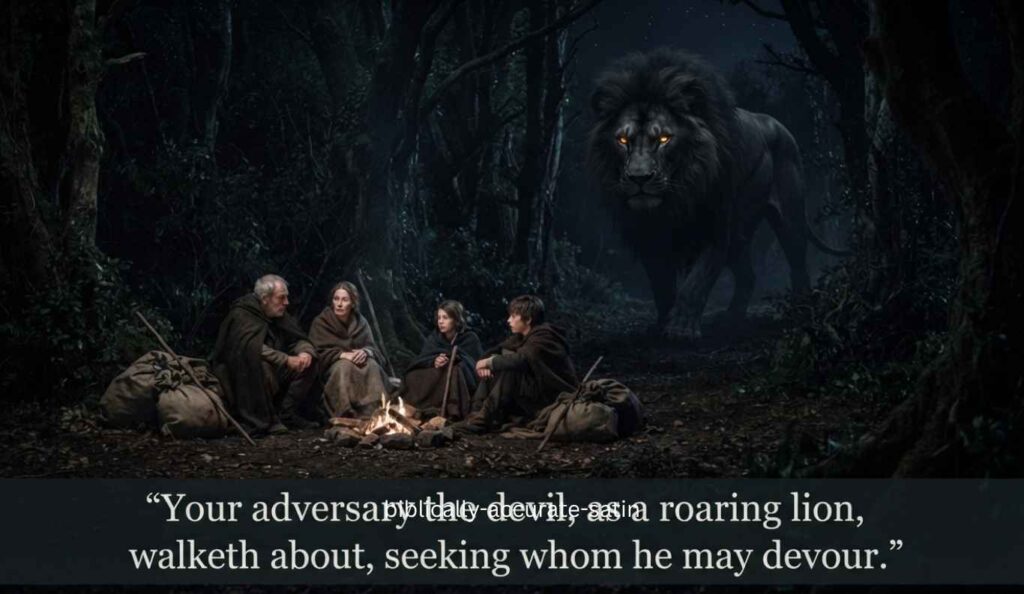
- The roaring lion of 1 Peter 5:8, which stresses predatory, relentless pursuit.
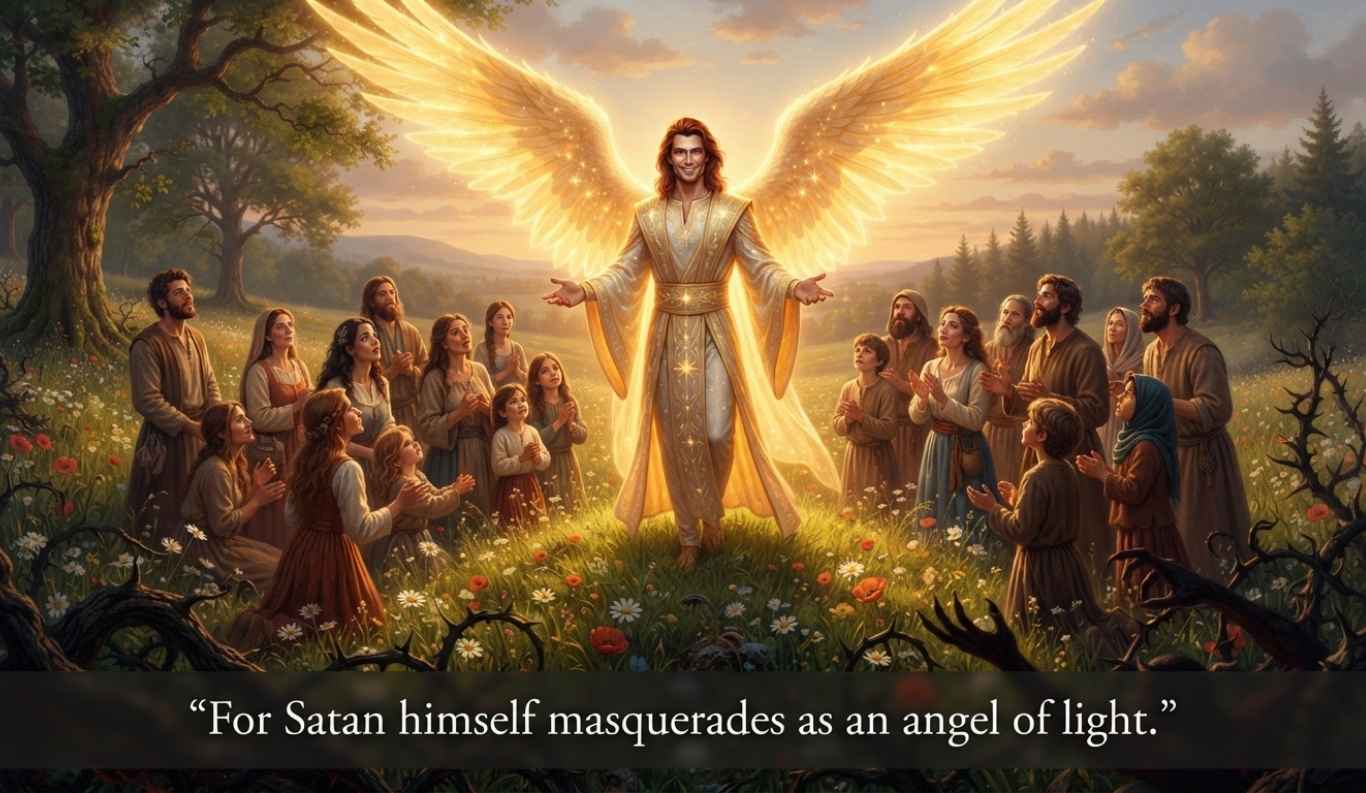
- The angel of light of 2 Corinthians 11:14, which stresses disguise and false beauty.
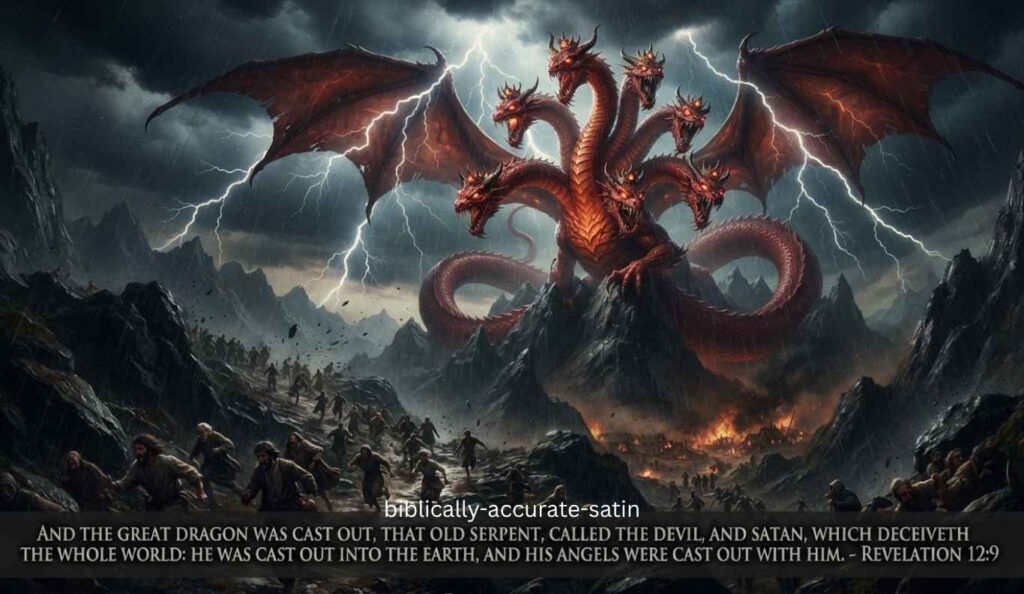
- The great red dragon of Revelation 12, which is apocalyptic symbolism, not anatomy.
Each image teaches a trait. None is a portrait.
The Adversary’s Operational Boundaries
Satan cannot act freely. In Job 1:12, God lets him touch Job’s possessions but not Job himself. Later God allows physical suffering but says, “spare his life.” The adversary cannot cross the line God draws.
Luke 22:31 shows the same pattern: Satan must ask to sift Peter, and Jesus prays for Peter. First Corinthians 10:13 and James 4:7 reinforce it. Believers can resist him because his power is real but derivative and constrained.
Deception as Primary Tactic
If one weapon defines Satan, it is deception. In John 8:44 Jesus says lying is his “native language.” In Genesis 3 he never denies God outright. He mixes truth with omission and says death won’t follow.
Paul adds that the “god of this age” blinds unbelievers (2 Corinthians 4:4). That’s why Ephesians 6 puts the belt of truth first. Against a master of lies, truth tested against Scripture is the best defense.
Biblical Versus Cultural Depictions of Satan
The gap between Scripture’s adversary and the one in our heads is huge. The horned devil is largely a product of art, literature, theater, and film, assembled over a thousand years. Very little of it comes from the text.
Seeing how that happened helps you separate biblical teaching from borrowed imagery. It also explains why many people reject “the devil” without ever meeting the actual biblical claim.
Literary and Artistic Influences on Satan’s Image
Two works did the most to shape Western belief. In Dante’s Inferno (early 1300s), Satan is a giant frozen figure at hell’s center, which made him ruler of hell in popular thought. In Milton’s Paradise Lost (1667), he is eloquent and tragic, declaring it better to reign in hell than serve in heaven.
Neither portrait is biblical. The Bible’s Satan is dangerous because he is subtle and constrained, not because he is a charismatic hero or a king of torment.
Historical Development of Visual Representations
Early Christian art usually showed Satan as a serpent or in human form. The horns and hooves came later, borrowed from figures like Pan and from pagan imagery during the medieval period.
Medieval mystery plays needed recognizable villains, so costumes with masks, horns, and fire effects spread the look. Red joined in through links to fire and Revelation’s dragon. By the Renaissance the picture was fixed, even though its biblical basis was close to zero.
Modern Media’s Portrayal of the Adversary
Modern media keeps remixing him. The Exorcist leans on demonic possession, a genuine biblical concept executed with Hollywood horror. The Devil’s Advocate makes him a seductive businessman, and the series Lucifer turns him into a charming protagonist.
Rock and metal use Satanic imagery as rebellion, and groups like The Satanic Temple treat him as a symbol of liberty, not a being to worship. These portrayals reveal cultural moods. They aren’t biblical theology.
Key Differences Between Scripture and Culture
| Question | Popular culture | Scripture |
| Looks | Red, horned, tailed | No description; may appear as light |
| Power | Rival to God | Created, limited, permitted |
| Hell | His kingdom | His place of punishment (Rev. 20:10) |
| Method | Visible deals, drama | Quiet deception, accusation |
Culture’s Satan announces himself. The Bible’s Satan disguises himself. That difference is more than trivia, because it affects whether believers recognize real danger when it arrives looking reasonable.
The Lucifer Debate: Biblically Accurate Analysis
Is Lucifer just another name for Satan? Many assume so, but the question is more complicated. The name appears in no Hebrew or Greek text of the Bible. It arrives through a Latin translation, and the link to Satan grew through later interpretation.
The following five sections walk through the evidence: the word’s history, two famous prophetic passages, how the link developed, and what Jesus actually said.
Etymology and Translation History
The Hebrew word is helel, used once in Isaiah 14:12, meaning “shining one” or “morning star.” Jerome’s Latin Vulgate (late 4th century) rendered it lucifer, an ordinary Latin word for “light-bearer” and for the planet Venus.
Early English Bibles carried the Latin word over as if it were a name, and the King James Version locked it in. Most modern translations say “morning star” or “son of the dawn.” The name “Lucifer” owes more to translation history than to any direct biblical statement.
Isaiah 14: Addressing Babylon’s King
Isaiah 14:3–4 states the target plainly: a taunt against the king of Babylon. The genre is a victory song mocking a fallen tyrant, using the elevated imagery common in ancient Near Eastern poetry.
Some theologians argue the language is too grand for a mere human and points to a supernatural being. Others say royal propaganda routinely used cosmic hyperbole. Either way, the chapter itself never names Satan, so any link is inferred, not stated.
Ezekiel 28: The Tyre Connection
Ezekiel 28 begins as an oracle against the prince of Tyre for claiming to be a god. From verse 12, the language shifts: “the seal of perfection,” present in Eden, an “anointed guardian cherub,” blameless until wickedness appeared.
Supporters of the Satan reading say no human fits that description. Skeptics reply that Eden imagery was a powerful rhetorical device against a proud king. Both views deserve respect, and conclusions should be held with interpretive humility.
Development of the Satan-Lucifer Association
The explicit link came from the church fathers. Origen and Tertullian read Isaiah 14 as describing Satan’s fall, and the idea spread through centuries of commentary. By the medieval era it was nearly unquestioned.
In the twentieth century, scholars applying historical-critical methods began asking whether these passages were ever about Satan. That debate continues. The tradition is old and respectable, but it is a reading of the text, not a line in the text.
Jesus’s Statement on Satan’s Origin
The strongest New Testament evidence is Luke 10:18: “I saw Satan fall like lightning from heaven.” Jesus speaks in the past tense, suggesting a completed event, and uses imagery of speed and finality.
Interpreters disagree on timing. Some see a primordial fall, others a defeat accomplished through the disciples’ ministry. Either way, the verse supports the broader view of Satan as a fallen heavenly being, even if the Isaiah link stays debated.
Theological Understanding of the Biblically Accurate Satan
Theology asks what role the biblically accurate Satan plays in the larger story. The answer is practical: he explains genuine opposition, sharpens the meaning of faith, and sets the stage for Christ’s victory.
Without a real adversary, the cross loses its cosmic dimension. That is why even cautious scholars treat Satan as theologically significant, not as an embarrassing leftover from a primitive worldview.
Satan’s Function in Biblical Narratives
In Job, Satan’s challenge exposes whether faith is genuine or self-serving. In Matthew 4, his temptation of Jesus shows that Christ overcomes where Adam failed. In Hebrews 2:14, Jesus shares our humanity to break the power of “him who holds the power of death.”
So the narrative role is consistent: Satan creates the test, and God’s faithfulness answers it. Evil is real, but it never escapes God’s governance.
Detailed Examination of Key Passages
Five passages anchor the picture:
- Job 1–2: Satan acts only with God’s permission.
- Zechariah 3:1–5: Satan accuses, and God replaces filthy garments with clean robes.
- Matthew 4:1–11: Three temptations, three Scripture-based answers from Jesus.
- Ephesians 6:10–18: The armor of God against spiritual forces.
- Revelation 12 and 20: Satan thrown down, bound, and finally judged.
Together they give the beginning, method, and end of his story.
Interpretations Across Christian Traditions
All major traditions affirm Satan as a real personal being, but they emphasize different things.
| Tradition | Emphasis |
| Catholic | Fallen angel, exorcism, sacramental protection |
| Reformed | God’s sovereignty limits Satan’s power |
| Pentecostal/Charismatic | Active spiritual warfare, deliverance |
| Eastern Orthodox | Enemy of theosis; answer is prayer and communion |
| Progressive | Sometimes symbolic: systemic evil or self-deception |
Symbolic readings struggle to explain texts where Satan acts as a personal agent with intentions.
Comparative Religious Perspectives on the Biblically Accurate Satan
Comparing faiths sharpens the biblical picture. Judaism, Christianity, and Islam all describe an opposing figure, yet each assigns him a different weight and job.
Seeing those differences also shows what is distinctive about the biblically accurate Satan: he is central to Christianity’s story of redemption, but he is never given independent authority over God.
Jewish Understanding of Ha-Satan
Rabbinic Judaism often equates ha-satan with the yetzer ha-ra, the evil inclination inside every person. That moves the struggle inward: discipline through Torah, prayer, and ethical living.
The Talmud still pictures him as a heavenly prosecutor, and one tradition notes the numerical value of “ha-satan” is 364, hinting he has no accusing power on Yom Kippur. Kabbalah adds the sitra achra, the “other side,” a more developed adversary within a mystical framework.
Islamic Conception of Iblis
In the Quran, Iblis refuses God’s command to bow to Adam, claiming he was made of fire and Adam of clay. Pride, not a coup attempt, drives his fall.
He doesn’t try to overthrow God. He asks for time until the Day of Resurrection to lead humans astray, and God grants it. As Shaytan, he can only whisper and entice, and believers seek protection through the phrase a’udhu billahi min al-Shaytan al-rajim.
Cross-Tradition Comparative Analysis
All three faiths agree that an adversary opposes human flourishing, works through deception and temptation, and is weaker than God. The differences lie in scale.
Christianity gives Satan the largest cosmic role, tied to redemption through Christ. Judaism keeps him functional and limited, stressing human responsibility. Islam emphasizes Iblis’s sin of pride and absolute divine sovereignty. Each answer reflects what the tradition cares about most.
Zoroastrian Influence on Development
Zoroastrianism taught a cosmic struggle between Ahura Mazda and Angra Mainyu. Because Jews lived under Babylonian and then Persian rule after the exile, some scholars see influence on the later, more personal Satan.
Others say Hebrew thought can explain the development internally. They also note a key difference: the biblical Satan is always created and subordinate, unlike an eternal evil principle. So the influence debate remains open, but the biblical Satan is not a copy.
Scholarly Debate: Satan’s Angelic Origin
Where did Satan come from? Scholars generally split into two camps: the fallen angel view and the created adversary view. The disagreement affects how we think about evil, free will, and God’s character.
Neither side is trivial, and each reads the same texts with different assumptions. The next five sections lay out both positions, what follows from each, and how believers can live well either way.
Traditional Fallen Angel Position
The dominant view across Catholic, Protestant, and Orthodox history holds that Satan was a glorious angel who rebelled through pride and took some angels with him. Support comes from Luke 10:18, Revelation 12:7–9, Jude 6, 2 Peter 2:4, and, through church tradition, Isaiah 14 and Ezekiel 28.
Its strength is theological: evil began in free choice, not in any flaw in God’s creation. That protects both divine goodness and genuine moral freedom.
Alternative Created Adversary View
A minority reading says Satan was designed for an adversarial role. It leans on Job, where he appears as a recognized member of the divine council doing a specific job, apparently with God’s blessing.
Supporters also cite Isaiah 45:7, where God says He creates light and darkness. Critics reply that the New Testament consistently treats Satan as an enemy to be defeated, which fits poorly with a role he is simply performing.
Theological Implications of Each Perspective
If Satan fell, evil comes from a creature’s free rebellion. The puzzle is how a perfect being could choose wrongly, and the usual answer appeals to the mystery of freedom.
If Satan was designed as an adversary, the origin of evil seems easier to explain, but a new problem appears: why condemn a being for doing what he was made to do? The fallen angel view fits more of the biblical evidence, while the other view usefully reminds us to respect early Hebrew context.
Tradition Versus Textual Analysis
Tradition carries weight. The church fathers knew the text and culture well, and their reading shaped Christianity for centuries. Dismissing that casually would be careless.
Yet careful textual analysis is the check that keeps tradition from replacing Scripture. When genre and context show Isaiah 14 is a taunt against Babylon’s king, that finding deserves a serious answer. Where both agree, hold conclusions with confidence. Where they clash, stay humble.
Practical Applications for Believers
Whichever origin theory you prefer, three practices follow from Scripture.
The first is vigilance: stay alert without becoming paranoid (1 Peter 5:8). The second is resistance: “Submit to God, resist the devil, and he will flee” (James 4:7). The third is assurance: Christ’s victory means the battle is real, but the outcome is certain. That balance keeps faith steady and fear small.
Cultural Impact of the Biblically Accurate Satan
Belief in Satan has shaped worship, prayer, art, and even psychology. It touches how churches baptize, how individuals pray for protection, and how entire communities talk about evil.
Looking at these effects shows how an idea rooted in a few Hebrew and Greek texts grew into a force across religion and culture, for better and for worse.
Influence on Religious Practices
Early baptism included renouncing Satan. Candidates faced west, the direction of darkness, rejected him, then turned east toward Christ. Catholic and Orthodox liturgies still preserve this renunciation.
Exorcism continues the work Jesus did, and Catholic canon law has formal procedures for it. The Lord’s Prayer asks to be delivered from “the evil one,” and many traditions include prayers for protection. These practices show belief in Satan is a pastoral reality, not just an idea.
Spiritual Warfare Approaches
Approaches range widely. Charismatic and Pentecostal circles use frameworks such as territorial spirits and generational curses, which critics say go beyond clear biblical warrant.
Reformed believers lean on ordinary means: Scripture, prayer, community, and sacraments. Catholics emphasize the Eucharist, confession, and formal prayers of protection. Most traditions agree on the core: truth, prayer, and faith are the primary weapons, as Ephesians 6 describes.
Contemporary Cultural Manifestations
The Satanic Temple, founded in 2013, uses Satan symbolically for individual liberty and church-state separation, not literal worship. Gothic subculture and black metal use dark imagery for rebellion or reflection on mortality.
Universities now offer courses on the devil, and scholars study his history across literature and religion. This saturation makes serious theology harder, because the symbol carries so many meanings that its biblical origin gets buried.
Psychological Effects of Satan Belief
Research links strong belief in a personal devil to both benefits and risks. Some people feel empowered, seeing their struggles as part of a meaningful battle. Others externalize blame, using demons to avoid personal accountability.
The unhealthiest forms involve paranoia and seeing every problem as an attack. A balanced view acknowledges the adversary, keeps personal responsibility, and keeps attention on God, not on the enemy.
Is the Biblically Accurate Satan Actually Red With Horns?
No. The Bible never says Satan is red, horned, or carrying a pitchfork. The biblically accurate Satan is described through metaphors such as serpent, lion, and dragon, plus the warning that he can appear as an angel of light.
The red-horned look came from medieval art, Pan-like imagery, and theater costumes. It sticks because it is easy to recognize, not because Scripture supports it.
Can the Biblically Accurate Satan Read Minds?
Scripture never says Satan knows human thoughts. That ability belongs to God alone (1 Kings 8:39). What the Bible shows is a being who observes behavior, studies weakness, and tailors temptation.
In Matthew 4 he even quotes Scripture, proving he knows the text. His skill is informed persuasion, not omniscience. That’s one more reminder that he is limited.
Why Does the Biblically Accurate Satan Disguise Himself as an Angel of Light?
Paul says in 2 Corinthians 11:14 that Satan disguises himself as an angel of light. Disguise works because people lower their guard around what looks good, wise, or spiritual.
That is why Scripture tells believers to test every spirit against truth. Deception rarely arrives looking evil. It arrives looking helpful, reasonable, or even religious, which is far more dangerous than a monster.
Did Satan Rule Hell According to the Bible?
No. Revelation 20:10 says he is thrown into the lake of fire, which makes hell his place of punishment, not his palace. The image of Satan ruling demons there came from Dante and later art.
In the Bible, God alone is judge and sovereign. Satan is a condemned figure awaiting sentence, not the king of a rival kingdom.
How Can Believers Resist the Biblically Accurate Satan Today?
Scripture’s advice is simple. Submit to God, stay sober and alert, put on the armor of God, and answer lies with truth, as Jesus did in the wilderness using Scripture.
Community, prayer, and honest confession remove the secrecy he thrives on. Resistance isn’t about dramatic confrontation. It is about steady faithfulness, trusting that the one who is in you is greater than the one in the world.
Synthesizing the Biblically Accurate Satan
Pulling it all together, the biblically accurate Satan is neither a harmless myth nor a cartoon ruler of hell. He is a real, cunning spiritual adversary who accuses, tempts, and deceives within limits set by God.
His greatest power is epistemic, working through what people believe about themselves, God, and reality. Yet Christ’s cross is described as decisive victory, and Revelation closes his story with final judgment. Understanding Satan biblically ends up teaching more about God’s sovereignty than about the enemy.
Biblically Accurate Demon (General Nature & Scripture)
Biblically accurate demons have no physical form in Scripture. They are spiritual beings, and any physical-sounding description is symbolic. The most common view is that they are fallen angels who rebelled with Satan (Revelation 12:4, Matthew 25:41). 1 Enoch offers another idea, linking them to spirits of the Nephilim.
Scripture calls them unclean spirits, lying spirits, and angels of Satan. They deceive, spread false teaching, and oppress or possess people, as in Mark 5, where Jesus casts out a legion. Their power is limited, and Colossians 2:15 says Christ triumphed over them by the cross.
Biblically Accurate Demon (Physical Descriptions The Two Exceptions)
Scripture gives physical-like descriptions to only two categories. First, the Se’irim, “hairy ones,” associated with goats (Leviticus 17:7). Their goat imagery likely influenced later horned-and-hooved depictions of demons.
Second, the locusts of Revelation 9, led by Abaddon, are apocalyptic symbolism for demonic oppression, not literal insects. As for Satan’s looks, the closest Scripture comes is 2 Corinthians 11:14, where he is transformed into an angel of light.
Biblically Accurate Seraphim
Seraphim come from the Hebrew saraph, “to burn,” and appear explicitly only in Isaiah 6:1–7. Each has six wings: two for flying, two covering feet, two covering faces. Alexander MacLaren read these as wings of service, humility, and reverence.
They also have faces, hands, feet, and voices that shake the temple. They worship God day and night, and one touches Isaiah’s lips with a burning coal to purify him. Tradition ranks them highest among angelic orders. The number isn’t specified, though 3 Enoch claims four, a source outside most canons.
Frequently Asked Questions
What Does the Bible Actually Say Satan Looks Like?
The Bible never gives a physical description of the biblically accurate Satan. Ezekiel 28 pictures a beautiful, adorned being before his fall, and 2 Corinthians 11:14 says he can still appear as an angel of light.
Was Satan Originally a Good Angel?
In the traditional reading, yes. The biblically accurate Satan was a glorious created angel who fell through pride, according to Luke 10:18 and, in the traditional view, Isaiah 14 and Ezekiel 28.
What Is Satan’s True Role in Scripture?
The biblically accurate Satan is an accuser, tempter, and deceiver. His Hebrew name means “adversary,” and the Bible shows him testing Job, tempting Jesus, and leading people away from God.
Is Satan Equal to God in Power?
No. The biblically accurate Satan is a created being who works only within limits God sets. Job shows he needed permission before touching Job’s property or health.
Does Satan Rule Hell in the Bible?
No, this is a popular myth. The biblically accurate Satan is never described as hell’s ruler, and Revelation 20:10 says hell is the place of his punishment.
What Type of Angel Was Satan Before He Fell?
Ezekiel 28:14 calls the figure an “anointed guardian cherub,” which many link to the biblically accurate Satan. That makes him a cherub, not a seraph, though the link is debated.
How Does Satan Attack People Today According to Scripture?
First Peter 5:8 compares the biblically accurate Satan to a prowling lion. His main tools are deception and temptation, and he rarely appears openly as a threat.
Conclusion
The biblically accurate Satan looks nothing like the red, horned figure of pop culture. Scripture shows an accuser and deceiver who is powerful but limited, who may disguise himself as light, and who is already defeated through Christ. That’s why the biblically accurate Satan is more serious, and less theatrical, than most people expect.
So test what you hear against the text, resist fear and obsession alike, and keep your eyes on God, not the enemy. Next time someone describes the biblically accurate Satan, ask where the Bible says it. Satan’s true danger has always been believing the lie. Start by reading Job 1, Matthew 4, and Ephesians 6 for yourself.

Emma Collins is an SEO expert in Blessings niche, creating optimized content for celebration, greetings, and ranking websites. EEAT expert.